
MARE researchers discuss PLAnT project at the Lisbon Geographical Society
MARE researchers participate, at the invitation of the Lisbon Geographical Society, in a conference of the Sea Seminar dedicated to the PLAnT project: Planning for Sustainable Use of the Ocean in Antarctica. 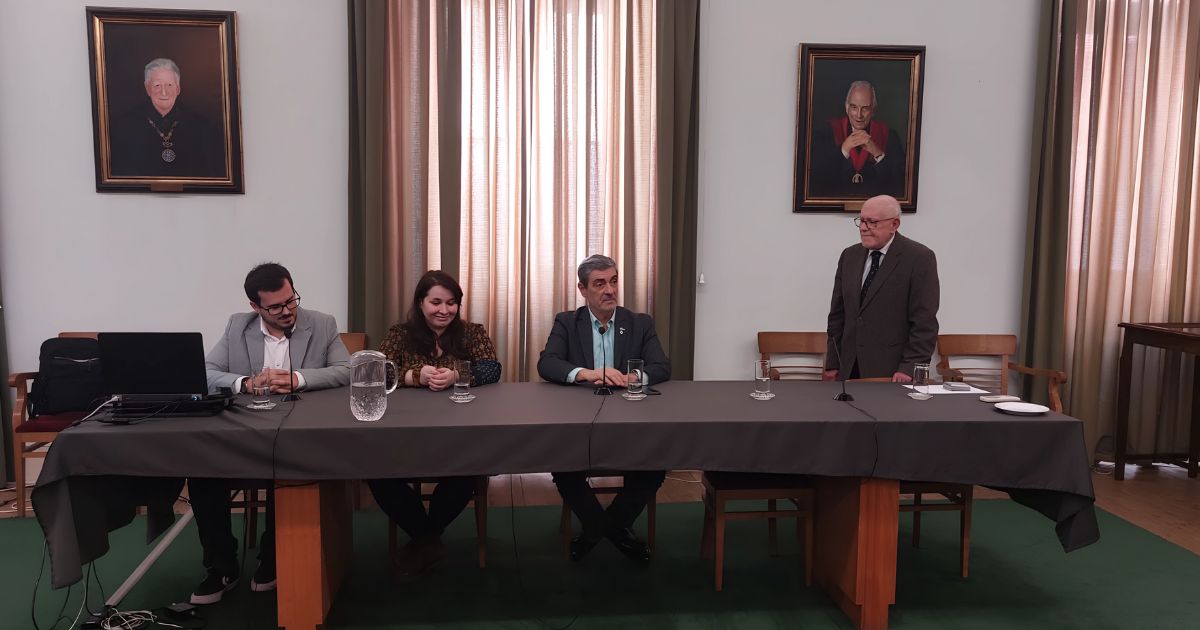
On October 27, the Lisbon Geographical Society (SGL) hosted another session of the Sea Seminar, this time dedicated to the PLAnT project: Planning for the Sustainable Use of the Ocean in Antarctica, which was attended by researchers Catarina Pereira Santos and Francisco Oliveira Borges (MARE/ARNET, Faculty of Sciences, University of Lisbon) and moderated by Ricardo Melo (MARE/ARNET, Faculty of Sciences, University of Lisbon). The session took place in a hybrid format and was part of the 6th cycle of conferences of the Sea Seminar, an initiative organized by the Ocean Geography Section of SGL, focusing on Strategy, Science, and Sustainability.
Francisco Oliveira Borges began by emphasizing the importance of maritime spatial planning (MSP), comparing it to the organization of our own home: “There must be a mapping that maximizes not only the opportunities and benefits for all users of the house, but also ensures the conservation of existing resources, so that we have a healthy home in the short and long term.” The researcher went on to issue a warning: there are more than 120 countries with MSP processes underway, covering virtually all regions of the ocean except one—Antarctica. Antarctica and the Southern Ocean are a key region for regulating ocean health and climate regulation, he explained, recalling that “what happens in one area of the globe can have impacts on others.”
Catarina Pereira Santos was responsible for presenting the overall vision of the PLAnT project. “PLAnT is the brainchild of Professor Catarina Frazão Santos, a pioneer in combining maritime spatial planning with the need to adapt to climate change,” she emphasized. OEM plans should not be static; they should integrate future projections of climate change, changes in species distribution, and changes in potential priorities for human uses. The project, which began in 2024 and will last for five years, is described by the researcher as a true case study, as it aims not only to study the integration of climate into OEM for the first time, but also to study the applicability of OEM in an international context.
The researcher presented a summary of the various phases of the project. In an initial phase, the Antarctic system will be characterized, followed by a projection of what may happen in the future. Only then will the planning of measures and solutions proceed, taking into account the characterization and projections made. An analysis of the region's governance process will also be carried out and, finally, the knowledge acquired in this case study will be transferred to other regions of the planet. Although Antarctica is being used as a case study, she explained, the aim is to apply its conclusions to other areas of the ocean without national jurisdiction, as “we need to conserve beyond our own waters."
Before starting the debate in the room, Ricardo Melo stressed the importance of initiatives such as this for society, emphasizing that, nowadays, the science that needs to be done is collaborative and multidisciplinary, as in the case of PLAnT. A dynamic debate followed, in which one of the topics that resonated most in the room was the scale of the project and the challenges of developing it in just five years. The truth is that “maritime spatial planning never ends, as time never stops running,” said Francisco Borges, reinforcing that OEM should be understood as a continuous and adaptive process, capable of responding to rapid environmental and social changes.
To close the conference, C/Alm. José Bastos Saldanha, President of the Ocean Geography Section of SGL, stressed that science only fulfills its role when it is communicated and closely monitored by society, and encouraged researchers to give visibility to the development of the project and its results. He closed the session by presenting MARE researchers with a commemorative medal for National Sea Day 2008, whose motto was “Ocean, Knowledge, and Citizenship,” which sums up the message that the president of the Ocean Geography Section made a point of emphasizing.
Text by Joana Cardoso