
MARE joins scientific studies to support the creation of the Cascais–Mafra–Sintra Community-Led Marine Protected Area
 Yesterday, 4 March, the protocol to launch the scientific studies supporting the proposal to establish the Cascais–Mafra–Sintra Community-Led Marine Protected Area (AMPIC) was signed. MARE – Marine and Environmental Sciences Centre is among the scientific institutions involved in these studies, contributing to the ecological characterisation of this coastal region.
The signing ceremony took place in Ericeira, within the municipality of Mafra, and brought together representatives from the Portuguese Government, the municipalities of Cascais, Mafra and Sintra, the Oceano Azul Foundation, and the scientific institutions involved in the project.
The future protected area is supported by funding from Fundo Ambiental, which supplies the resources necessary to conduct the scientific studies that will underpin the proposal for the marine protected area.
MARE’s contribution
MARE is participating in the scientific work through teams from several of its Regional Research Units (URIs), involving researchers with different areas of expertise in marine ecology and coastal management.
According to Joana Robalo, Vice-Director of MARE, the centre’s involvement highlights the extensive experience of its research teams in studying coastal ecosystems.
“MARE’s participation in this project is a natural outcome, since several of our teams already work in these areas and in the field, carrying out the same types of studies that will now be developed.”
Bernardo Duarte, coordinator of MARE-ULisboa at the Faculty of Sciences of the University of Lisbon, highlights the importance of this collaboration with the region's municipalities.
“This project is very important for MARE-ULisboa because it strengthens collaboration with the municipalities in the metropolitan area where we operate and increases the visibility of our work in the conservation and monitoring of the marine environment.”
For José Carlos Ferreira, representing the MARE-NOVA coordination at NOVA FCT, the initiative represents a significant opportunity for scientific research.
“The creation of a community-led marine protected area involving the municipalities of Cascais, Mafra and Sintra represents an important scientific opportunity for MARE-NOVA, as it is a cross-cutting project that integrates several research dimensions, including marine sciences, coastal ecology, environmental governance and spatial planning.”
 Scientific teams and fieldwork
The scientific studies will be carried out throughout 2026 by multidisciplinary teams working to characterise different components of marine ecosystems along the coastline of the three municipalities.
Researchers from MARE-ULisboa involved in the field campaigns include Bernardo Quintella, Ana Filipa Silva and Nuno Castro, who are contributing to field data collection and the characterisation of marine biodiversity.
According to Bernardo Quintella, the diversity of methods required to study the ecosystems in this region requires collaboration between several research teams.
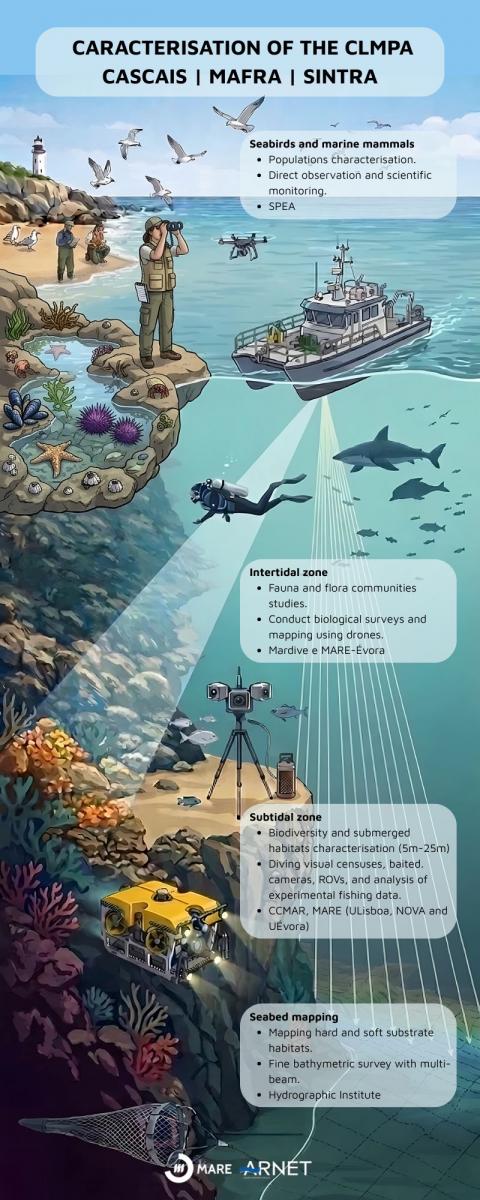
“The work involves very different methodologies, from scientific diving to underwater video systems and bathymetric surveys. It would be impossible, in such a short time, for a single team to carry out all this work.”
The researcher also notes that the studies build on previous scientific work conducted in this coastal region.
“This project complements a scientific campaign carried out previously in this area and will deepen our knowledge of the biodiversity and marine habitats of this coastline.”
MARE-NOVA is also involved in the studies through several researchers, including Gonçalo Silva, who is responsible for one component focusing on fish communities and marine habitats.
“Using baited cameras, we can deploy cameras throughout the area covered by the three municipalities, down to depths of 100 metres, allowing us to characterise not only the habitats but also fish and macrofauna communities.”
According to the researcher, field campaigns will be prepared in the coming months.
“We will start preparing the campaign, which should take place mainly during the summer, when sea conditions are more favourable for this type of work.”
The project also involves teams from MARE at the Universidade de Évora, including
David Jacinto, who is contributing to the characterisation of coastal marine resources.
“This work, carried out in consortium between the University of Évora, MARDIVE and researchers from MARE, builds on previous work and on the long-standing professional collaboration between these teams.”
Within this component, the team will also contribute to the study of species relevant to coastal ecosystems.
“The University of Évora will be more closely involved in mapping marine resources in the intertidal zone, including goose barnacles, mussels and limpets, as well as other reef-forming species.”
The association MARDIVE coordinates one of the project's scientific components through a team comprising Miguel Pais, André Lima, Carolina Miranda, and Mariana Coxey.
According to Miguel Pais, the data already collected in the region can directly support conservation decisions.
“We have a very large body of data for this area, and we can place it at the service of decision-making and conservation.”
For Bernardo Quintella, the main objective of these studies is to support the definition of the future protected area based on solid scientific knowledge.
“The aim of these studies is to identify areas with species or habitats of greater conservation interest and to produce the scientific information needed to support the spatial planning of the marine protected area.”
Scientific knowledge as the basis for the marine protected area
The studies now underway will deepen scientific knowledge of the marine ecosystems along the coast of Cascais, Mafra and Sintra, helping to identify habitats and species of high ecological value in this region.
This work also builds on research initiated in 2022, during the Oceano Azul Cascais | Mafra | Sintra scientific expedition, carried out along this coastline.
Over approximately 10 days, several research teams worked aboard the Santa Maria Manuela vessel, collecting the first scientific data on the biodiversity and marine habitats in this region.
The information gathered during that campaign provided the initial knowledge base on the ecosystems of this coast and helped identify areas of scientific interest, which will now be studied in greater detail.
In parallel with ecological characterisation, the project also includes socio-economic studies and a participatory process with local communities, involving stakeholders connected to the sea and coastal activities.
This participatory process is a central element of the initiative, allowing the integration of scientific knowledge produced by research teams with local knowledge and the needs of communities that depend on these ecosystems.
Together, these efforts will contribute to developing a proposal for a marine protected area that combines biodiversity conservation, scientific knowledge production, and the sustainable management of marine resources.
In the context of the international 30x30 target, which aims to protect at least 30% of the ocean by 2030, the scientific knowledge produced by research centres such as MARE is essential to support the identification and management of areas of high ecological value.
During the protocol signing ceremony, the Portuguese Minister for the Environment and Energy, Maria da Graça Carvalho, emphasised the role of science in this process.
“Protecting the ocean requires solid scientific knowledge. Only through science can we identify the areas that need protection and ensure the sustainable management of our marine ecosystems.”
Text and image: Vera Sequeira
Edition support: AI tools