
Can offshore wind farms coexist with marine biodiversity?
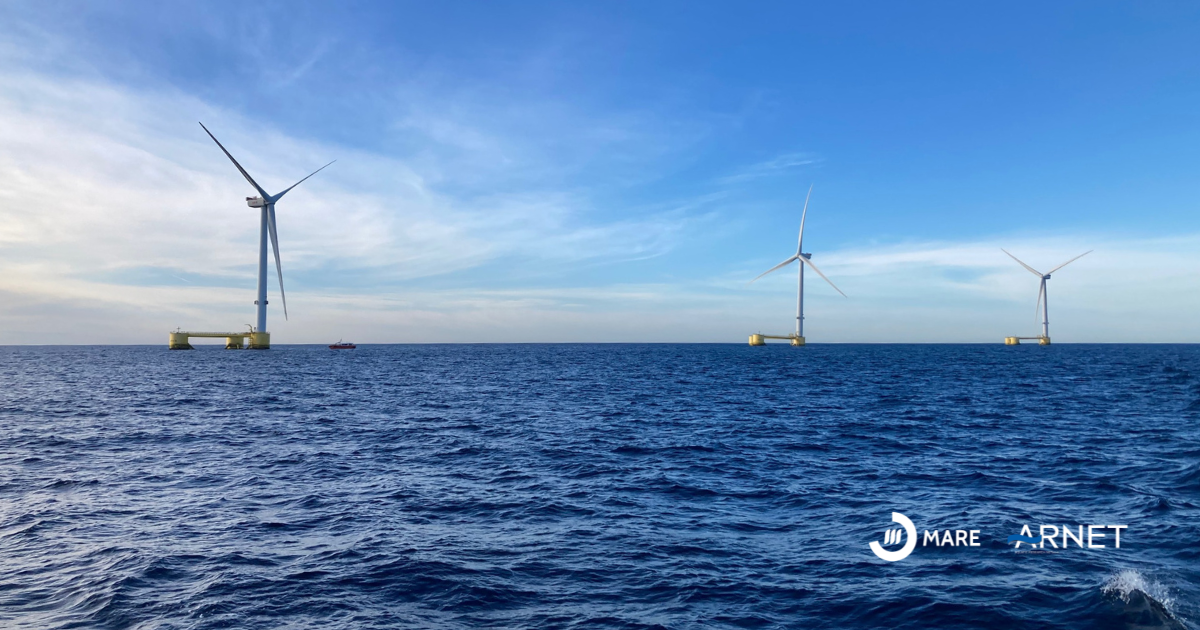
According to the recent report by Ocean Winds, developed on the basis of environmental monitoring campaigns with the contribution of MARE, the answer appears to be “yes”.
Ocean Winds is the company responsible for the WindFloat Atlantic offshore wind farm, installed off the coast of Viana do Castelo, pioneering in its use of floating platforms. The installation, comprising three offshore wind turbines, has been in operation since 2020, approximately 20 km from the coast of Viana do Castelo.
The report “Coexistence between floating offshore wind energy and biodiversity: a report based on data from WindFloat Atlantic”, presented at the annual WindEurope event, in Madrid, is based on environmental monitoring campaigns focused on biological components such as phytoplankton, zooplankton, necto-benthic invertebrates, including octopus, and fish. It was developed by the independent consultancy Blue Grid, with contributions from MARE – Marine and Environmental Sciences Centre, coordinated by José Lino Costa. It also involved researchers Bernardo Quintella, Ana Brito, João Paulo Medeiros, Joana Cruz and Filipa Silva from MARE’s Regional Research Unit (RRU) at the Faculty of Sciences of the University of Lisbon, and Sónia Cotrim Marques and Sérgio Leandro from MARE’s RRU at the Polytechnic University of Leiria.
Through the monitoring services provided, MARE researchers recorded an increase in the abundance and biomass of octopus and certain fish species, particularly elasmobranchs (cartilaginous fish such as sharks and rays) and sole, within the wind farm area compared with adjacent areas. They therefore conclude that the fishing exclusion zone established around the wind farm promotes a protective effect relative to neighbouring areas where fishing is carried out regularly.
Fotografia: Sónia Cotrim