
This week, MARE celebrates the science it conducts in Antarctica. Join us on this expedition!
1 December marks Antarctic Day, the date on which, in 1959, the Antarctic Treaty was signed, establishing the continent as a place dedicated to peace and science. MARE – Centre for Marine and Environmental Sciences marks the date with a week entirely dedicated to the stories and research that our teams have been developing in Antarctica. 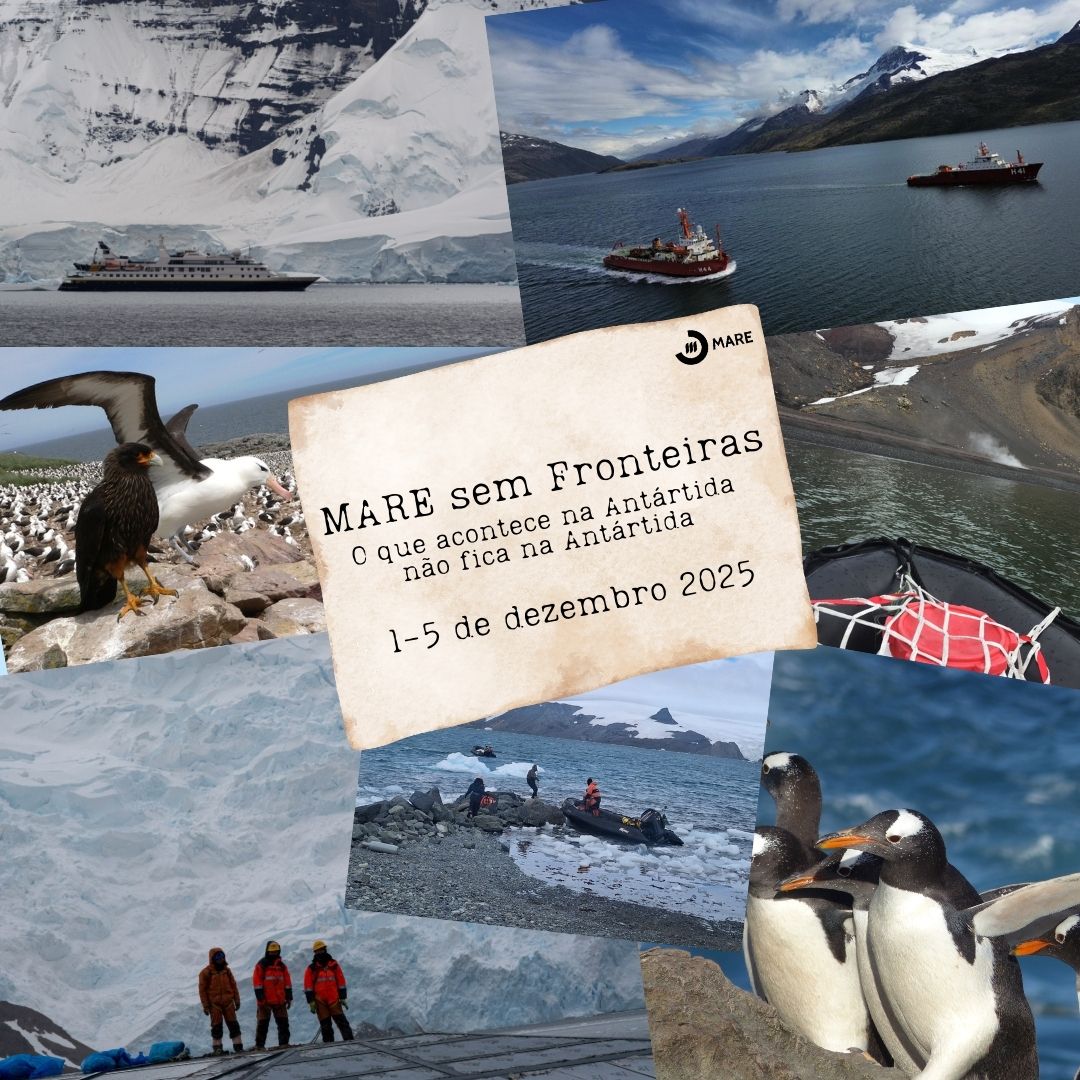
Over the last few years, researchers from different scientific fields have taken Portuguese science to the ends of the earth: they study the base of the food chain, search for pollutants on remote islands, have been tracking seabirds for two decades, and bring marine spatial planning to the international negotiating table. Many describe Antarctica as a changing environment and, at the same time, as the place that best reveals the fragility of the planet.
For those who have been there, the journey begins long before they see ice. Catarina Guerreiro, a researcher at MARE/ARNET in CIÊNCIAS ULisboa, spent weeks preparing, which included training in safety and basic life support, preparing the material and equipment to take, days on planes and long sea crossings until she reached her final destination. The moment she saw the first iceberg was etched in her memory forever, as was the attack by a group of orcas on a minke whale that she witnessed in the middle of the scientific campaign, when the sea turned red and the seagulls threw themselves into the water, impatiently fighting over every fragment of the whale.
For Graça Sofia Nunes (MARE/ARNET in Sciences ULisboa), going to Antarctica was ‘the’ defining moment in a journey that took her from her master's thesis to the publication of an article in Communications Earth & Environment (Nature Portfolio). In her work, Graça used time series and satellite data to study phytoplankton blooms in the Ross Sea, discovering that the base of the food chain responds in complex ways to environmental changes.
Bernardo Duarte (MARE/ARNET in Sciences ULisboa) never set foot on the white continent, but he prepared everything so that the scientific work could be done there. He moved half of the laboratory to Cádiz, where the material was loaded onto the ship Hespérides, ensuring that the analyses could be carried out in the field. The aim was to study Deception Island: a living laboratory, where active volcanism releases natural mercury and where signs of human presence are beginning to emerge with the detection of cancer drugs, illicit drugs and other contaminants.
Others return, year after year, to the same places and the same colonies. For more than two decades, Paulo Catry (MARE/ARNET at Ispa - University Institute) has been monitoring brown-norfolkstorm petrels in the Falkland/Malvinas Islands, reviewing the same pairs and relating the success of their offspring to colder or warmer years.
On the governance front, Catarina Frazão Santos' team (MARE/ARNET in Sciences ULisboa) brought the issue of marine spatial planning to the Antarctic Treaty meetings for the first time, showing that managing a rapidly changing ocean requires clear rules on where certain activities can and cannot be carried out, and that Antarctica should be no exception.
Throughout this week, MARE's website and social media will delve into these stories. Each day will focus on a different theme. What they all have in common is that they show that, despite its distance, Antarctica is connected to our daily lives.
As the researchers summarise, ‘what happens in Antarctica does not stay in Antarctica’. What we do here reaches there, and what changes there affects us all.
Written by Vera Sequeira and Joana Cardoso