
Seminar "The Camarinha in Caminha and Galicia" brought together specialists from Portugal and Galicia
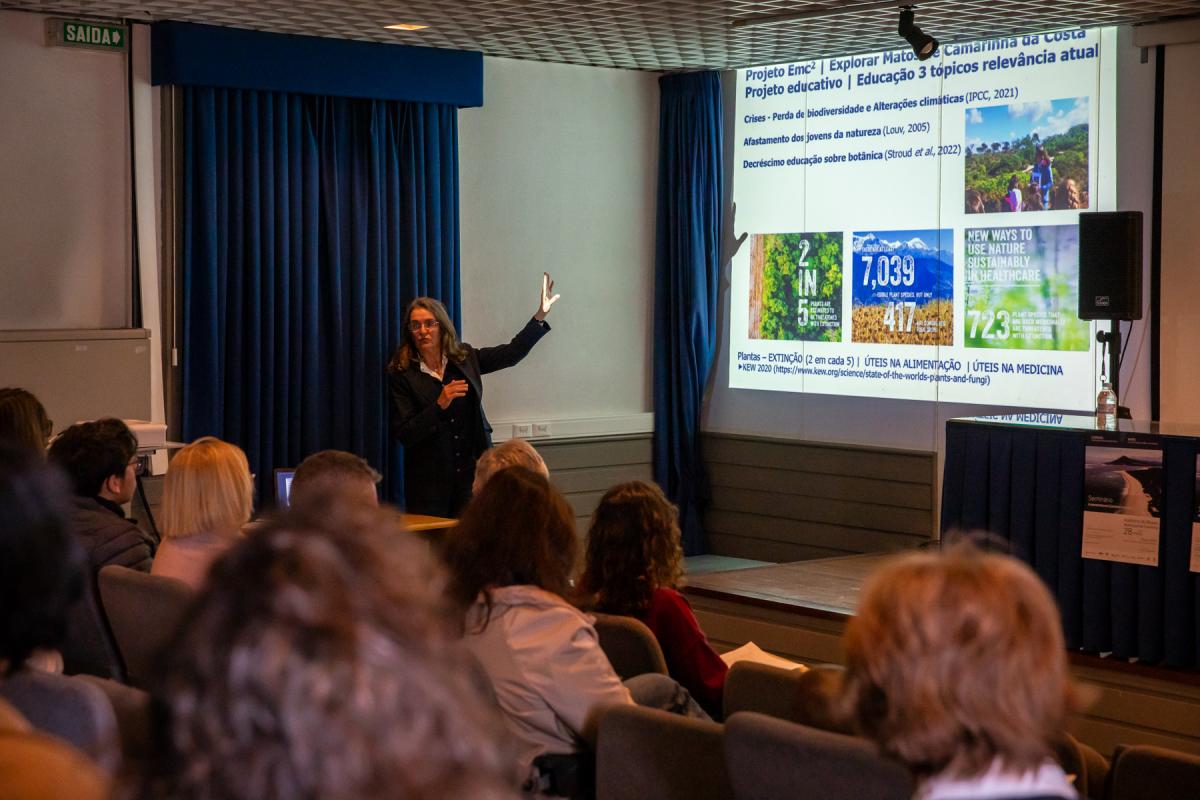
The Auditorium of the Municipal Museum of Caminha hosted the seminar "The Camarinha in Caminha and Galicia", last Saturday, March 28.
The initiative was organised jointly by the COREMA Heritage Association and MARE - Marine and Environmental Sciences Centre, with the support of the Municipality of Caminha. It brought together researchers and specialists from Portugal and Galicia to share data related to the dissemination of the camarinha, its history, and the challenges of its current conservation.
The programme began at 9:30 with an initial session of three lectures. The first was on 'The history of camarinha conservation' by José Gualdino Correia, President of COREMA, followed by the presentation on 'The history of the Mata do Camarido' by Ana Isabel Lopes, researcher at CITCEM, Faculty of Letters, University of Porto. This was followed by 'The Emc2 Project in the dissemination and conservation of camarinha' presented by Alexandra Abreu Lima, researcher at MARE/ARNET and the National Institute for Agricultural and Veterinary Research (INIAV, I.P.).
At the end of the morning, the second session of lectures featured a presentation on 'Conservation of camarinha in the Mata do Camarido: propagation and phytochemical characterisation', by Francisca Moreira, a Master's student at the School of Agriculture of Ponte de Lima, of the Polytechnic Institute of Viana do Castelo. The final lecture of the morning was 'A camariña en Camariñas: History, dynamics and conservation', by Mateo Pasantes Campaña of the University of Corunha.
The afternoon session included a visit to the Mata do Camarido, where participants could see the sites where, in October 2025, approximately 5000 camarinhas were introduced. This initiative at the time received the support of students and teachers from Caminha schools, COREMA volunteers, Seixas scouts, the Manager of the National Forest of Camarido (ICNF), and a group of forest rangers from ICNF. These plants were obtained through cuttings in the Raíz da Terra - Âncora nurseries, which was a partner in the initiative, in order to increase the number of plants of this species and thus prevent its eradication in Caminha.
In this way, COREMA and MARE continue in collaboration with various entities to disseminate and conserve the camarinha, a plant that by only existing in Portugal and Spain is an Iberian endemic species, with ecological and cultural value, constituting a natural heritage to be preserved.