
From Science to Impact: MARE’s 2025 in Numbers
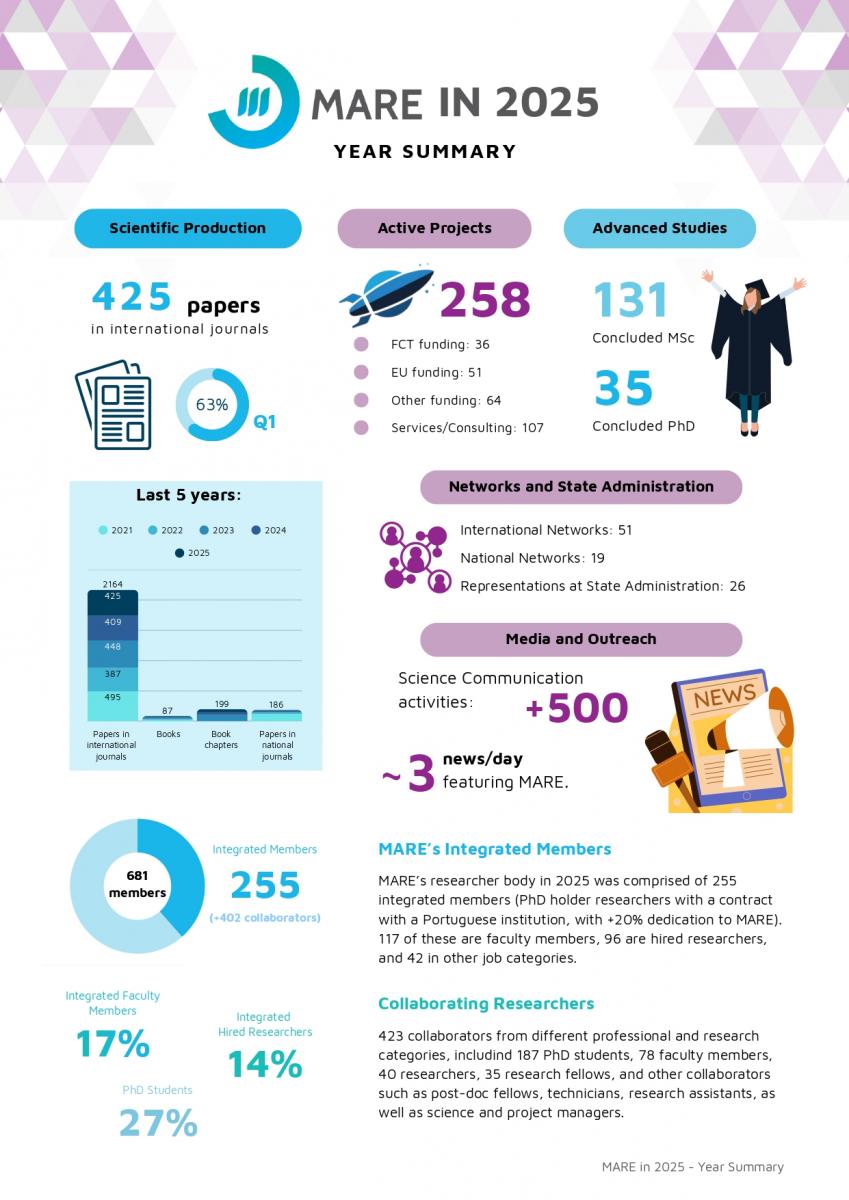
In 2025, MARE reinforced its role in aquatic science while strengthening its contribution to society, policy and sustainability. With 425 scientific publications, 258 active projects and over 500 science communication activities, the centre continues to translate knowledge into real-world impact.
Advancing our knowledge of aquatic ecosystems.
MARE’s scientific production remained strong in 2025, with 425 publications in international journals, 63% of which were published in top-ranked (Q1) journals. These results reflect the centre’s continued contribution to advancing knowledge on aquatic ecosystems.
Supporting solutions to real-world challenges
With 258 active projects, spanning European, national and applied funding schemes, MARE continues to contribute to the development of evidence-based solutions addressing key environmental and societal challenges.
Training the next generation of experts
In 2025, MARE contributed to the completion of 131 MSc and 35 PhD degrees, reinforcing its role in advanced training and in building the next generation of scientists and professionals. In addition, MARE currently has 197 PhD and 152 Master’s thesis projects underway.
Engaging society through science
MARE carried out over 500 science communication activities and maintained a strong media presence, averaging around 3 news mentions per day. These efforts contribute to increasing public awareness and strengthening the connection between aquatic science and society.
A strong and connected research community
The MARE community comprises 255 full members and over 400 staff members, distributed across eight Regional Research Units and various partner institutions, forming a broad and diverse network that strengthens scientific collaboration and institutional impact at national and international levels.
These results reflect MARE’s continued commitment to bridging science, policy and society, contributing to a more sustainable and informed future for aquatic ecosystems.
Text: Vera Sequeira
Image: Mélanie Costa