
10th anniversary MARE booklet now available for public access
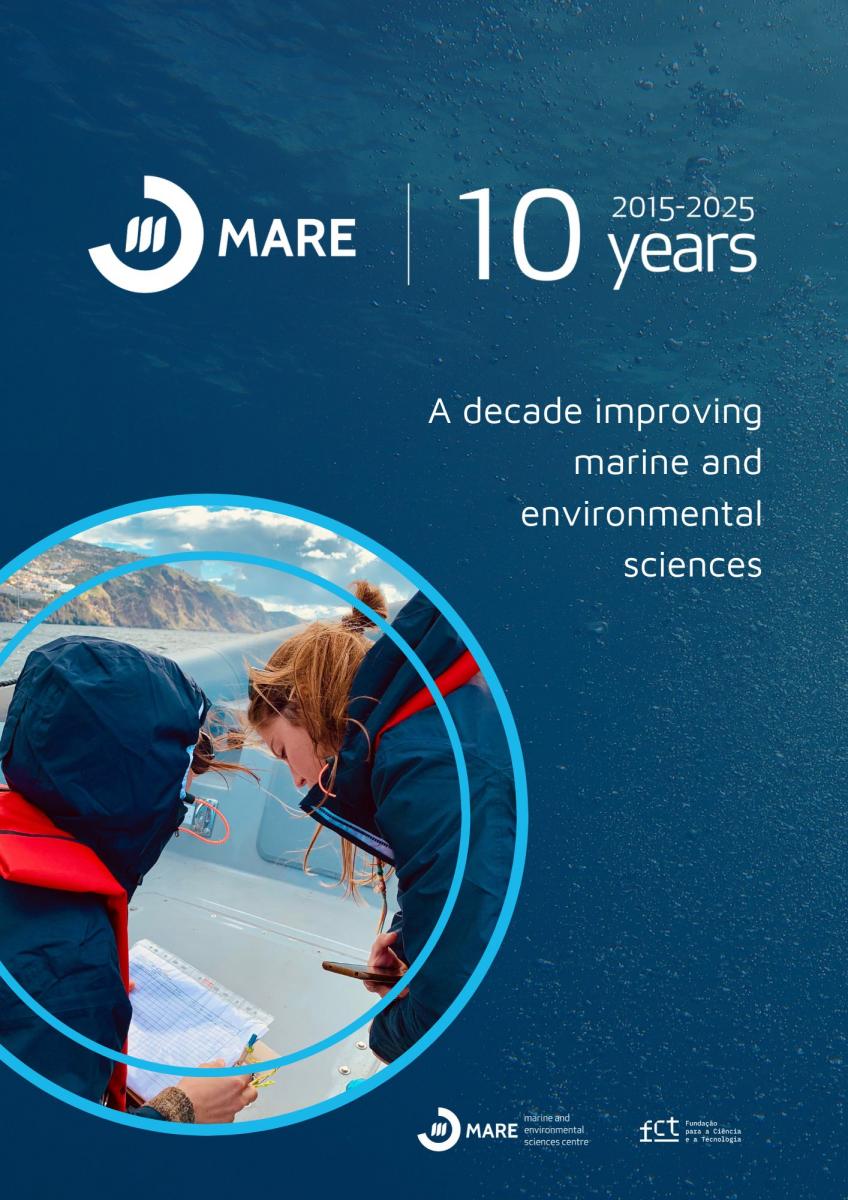 The booklet “MARE 10 years (2015–2025): A decade improving marine and environmental sciences”, a MARE publication that brings together the main scientific, institutional and societal milestones achieved by the centre over the past decade, is now publicly available on the MARE portal. The publication celebrates MARE’s journey since 2015, presenting key moments in the centre’s history, its areas of impact, and its contribution to the knowledge and sustainable management of aquatic ecosystems.
From MARE to the scientific and institutional community
What the booklet offers:
- MARE through the years, a chronological overview revisiting key moments, major collaborations and milestones that have shaped MARE.
- 10 years, 10 highlights, a section showcasing areas where MARE’s research has had lasting impact, from scientific advances to contributions to public policy and management practices.
- Voices from MARE, featuring testimonies from coordinators and researchers, offering personal reflections on MARE’s growth, mission and vision.
The digital version is freely accessible on the MARE portal, reinforcing the centre’s commitment to transparency, scientific communication and knowledge sharing.
10 years, 10 areas of impact
Over the past decade, MARE has made a significant contribution across ten strategic areas of aquatic science and ecosystem management. As MARE’s Director, Pedro Raposo de Almeida, notes: “Throughout this decade, MARE has consolidated its original areas of research, strengthened its connection to the territory through its regional research units, supported public policies in the field of aquatic ecosystems management and conservation, and expanded areas of intervention. MARE has embraced new challenges in the blue economy while maintaining the commitment to undergraduate and postgraduate training.”
The booklet highlights this scientific, territorial and human journey across ten major themes. In biodiversity conservation, MARE has revealed new species, restored essential habitats and helped redefine how Portugal protects its ecosystems, showing how science can transform territories and communities. In the field of marine litter and waste management, the centre has contributed to major public policies and to the advancement of the circular economy, supporting national and European decision‑making with pioneering research.
Environmental monitoring has gained new networks, technologies and methodologies that allow long‑term assessment of rivers, estuaries and the ocean, providing the scientific basis for more informed decisions. In the study of invasive species, MARE has deepened understanding of their pathways, impacts and control strategies, strengthening the resilience of aquatic ecosystems.
Marine resource sustainability has been advanced through co‑management models and innovation in aquaculture, bringing together science, fishers and authorities to promote practices that balance conservation and economic activity. In the area of climate change, MARE has developed indicators, scenarios and nature‑based solutions that help territories adapt and plan for the future.
MARE has also played an active role in the creation and management of Marine Protected Areas and in marine spatial planning, contributing to policies that balance protection, sustainable use and scientific knowledge. Research on the dynamics of water and sediment has helped decode geological histories and understand hydrological processes that shape landscapes, natural hazards and territories.
In biotechnology, MARE has transformed marine resources into solutions for health, food and industry, developing biomaterials, bioactive compounds and sustainable alternatives that support the blue economy. Finally, through societal interfaces, the centre has worked closely with communities, schools and decision‑makers, promoting more participatory, fair and sustainable approaches to managing aquatic ecosystems.
With this publication, MARE celebrates its journey and reaffirms its role as a national and international reference in marine and environmental research, contributing to science and public policy.
The booklet was produced by the MARE Communication Office, responsible for authorship, editing, graphic design and editorial coordination: Mélanie Costa, Filipa Lacerda, João Pequeno, Marco Simões, Patrícia Carvalho, Vera Sequeira and Zara Teixeira.
The booklet is available here.
Text: Zara Teixeira