
World Wildlife Day: The Sado Estuary reveals its ecological importance for seahorse conservation
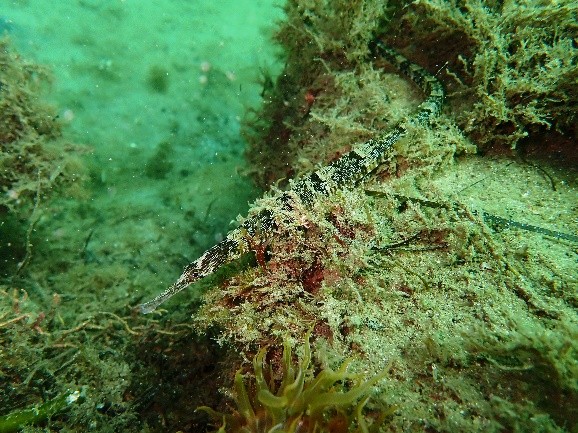
Scientific studies carried out under the Cavalos de Tróia and CavalSado projects have shown that the Sado Estuary holds high ecological value for seahorses, highlighting how critical it is to ensure the conservation of this ecosystem. The projects used scientific diving and close collaboration with local entities to assess the distribution, abundance and diversity of seahorses and pipefish throughout the estuary, particularly in seagrass meadows, oyster beds and port structures.
Seahorses and/or pipefish were observed in 15 of the 19 surveyed sites. In total, 57 individuals belonging to five species were recorded: the long-snouted seahorse (Hippocampus guttulatus), the short-snouted seahorse (Hippocampus hippocampus), the greater pipefish (Syngnathus acus), the broad-nosed pipefish (Syngnathus typhle) and Nerophis sp.
The results identified three priority conservation areas — Soltroia, Tróia Marina and Marbella Marina — due to the abundance and diversity of seahorses and/or pipefish found there, effectively functioning as biodiversity hotspots. Several threats to these emblematic species were also identified, including habitat degradation, marine litter and underwater noise.
For the first time, a garden of gorgonians, cold‑water corals, was documented at shallow depth and on mobile substrate, a type of occurrence not previously reported in estuarine environments.
This scientific information provides a fundamental reference for future monitoring and for supporting management decisions, spatial planning and the definition of protection measures in the Sado Estuary. The work reinforces the importance of science‑based solutions, cooperation, community engagement and integrated strategies to strengthen the resilience of estuarine ecosystems.
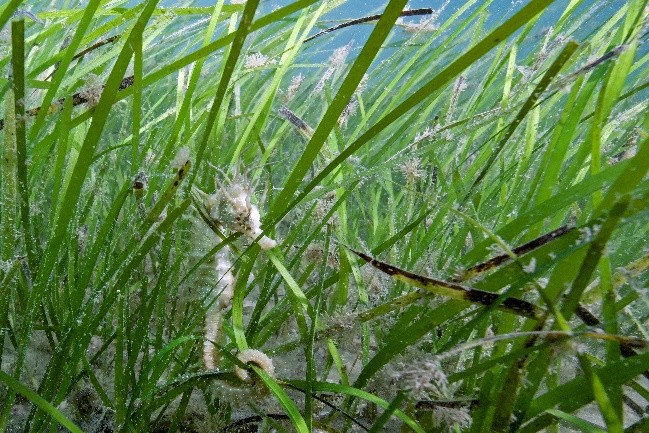 Seahorses are flagship species for conservation: they are particularly vulnerable, have low dispersal capacity and depend heavily on specific, and often fragile, habitats. They serve as indicators of environmental quality in coastal and estuarine systems. Protecting them and their habitats directly contributes to safeguarding associated biodiversity and ensuring the sustainability of marine ecosystems.
This research is the result of collaboration among several public and private entities, including MARDIVE – Associação Ciência e Educação para a Conservação da Biodiversidade Marinha, MARE – Centro de Ciências do Mar e do Ambiente, NOVA FCT – Faculdade de Ciências e Tecnologia da Universidade NOVA de Lisboa, ARNET – Rede de Investigação Aquática, ICNF – Instituto da Conservação da Natureza e das Florestas, TRÓIA‑NATURA, the Mares Circulares programme (an initiative of Coca‑Cola Europacific Partners managed by LPN – Liga para a Proteção da Natureza), and the Municipality of Setúbal.
The Cavalos de Tróia and CavalSado projects therefore represent a decisive step in understanding and valuing the natural heritage of the Sado Estuary, reinforcing the role of science as an essential tool for marine conservation in Portugal.
Text: Gonçalo Silva and Diana Rodrigues
Image above: © Diana Rodrigues. Image below: © Nuno Vasco Rodrigues