
MARE researchers confirm: Flying gurnard communicates using sounds and movements
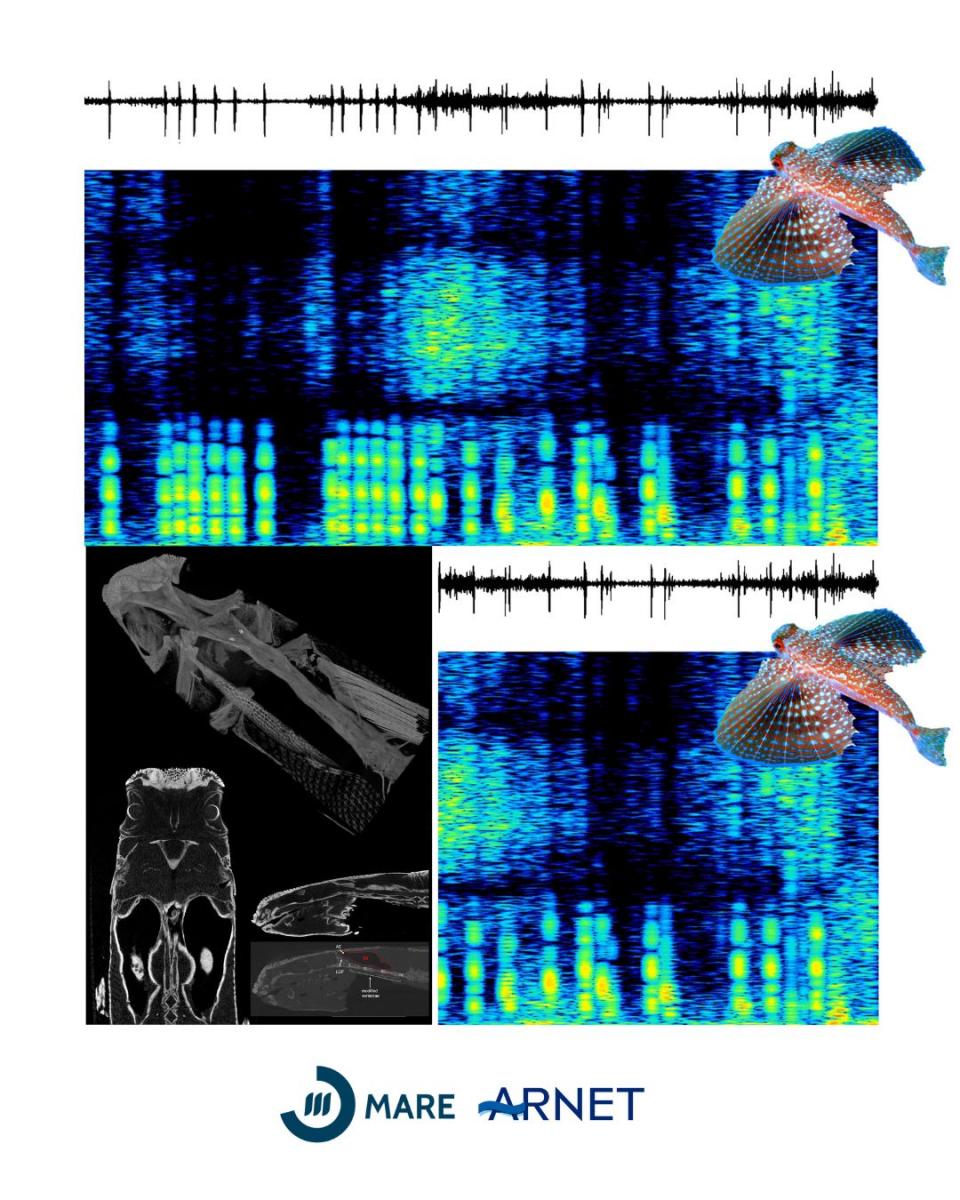
Since the 1970s, scientists had suspected it, but only now has the proof arrived: the flying gurnard (Dactylopterus volitans) is not only visually striking but also a natural communicator. A new study, published in the Journal of Zoology, demonstrates for the first time that this species combines acoustic "grunts" with fin movements to communicate underwater.
The research featured the work of Manuel Vieira and Clara Amorim, researchers from MARE and ARNET – Aquatic Research Network at the Faculty of Sciences of the University of Lisbon. They joined forces with researchers from ce3c – Centre for Ecology, Evolution and Environmental Changes and Change – Institute for Global Change and Sustainability, as well as the Universities of Zagreb and Venice, to decipher this behaviour.
Artificial intelligence at the service of bioacoustics
To obtain the new data, the team went beyond direct observation. They combined action cameras with artificial intelligence algorithms to isolate and analyse each sound. What they discovered were two types of short, repeated sounds that vary in duration, frequency, and rhythm.
These sounds almost always occur at the same time as the fish opens its large pectoral fins, which are marked by blue spotted patterns. However, the biggest surprise came from the size of the "interlocutors": even juveniles, under 10 centimetres in length, are already capable of emitting these signals. The data was collected in Pasjača, Croatia, in the Adriatic Sea, where researchers observed the fish during dives to monitor non-native species.
Hearing what cannot be seen
This study reinforces the fact that the ocean is far from being a silent place. "Many species possess their own 'acoustic signature, which can reveal patterns of activity and ecological interactions," explains Manuel Vieira. For the researcher, using sound as a working tool allows them to go further: it helps detect invasive species or identify reproductive periods that would otherwise go unnoticed by the human eye. "For a long time, the widespread perception was that the underwater environment was a silent space. This idea is far from reality," he emphasises.
More than just deciphering a species' behaviour, this discovery highlights the fundamental role of bioacoustics in monitoring ocean health. For MARE | ARNET, this research is a clear example of how cutting-edge technology and fieldwork unite to protect biodiversity, proving that to understand how marine ecosystems function, we must first learn to listen to what they have to tell us.
Text: Vera Sequeira
Link article
Link vídeo+audio
Clipping
Observador
Wilder
GreenSavers