
Floods and extreme river discharges challenge MARE research in Portuguese river basins
Recent storms, persistent rainfall episodes and exceptional increases in river discharge across several Portuguese river basins are affecting numerous urban and agricultural infrastructures. Scientific research is also facing significant operational constraints and methodological challenges, as is research carried out by MARE – Marine and Environmental Sciences Centre in rivers, estuaries and coastal areas.
From the Minho to the Guadiana, teams monitoring environmental quality, sediment dynamics, native and invasive species, and migratory fish report disturbances that may result in equipment losses, interruptions in time series and fieldwork, and ecological changes in aquatic ecosystems.
Infrastructure under pressure
Several researchers have indicated the potential impact on monitoring stations and field devices. Within the COASTNET – Rede Portuguesa de Monitorização Costeira, multiparameter probes, mooring systems and acoustic receivers may have been displaced, buried or damaged due to intense sediment and debris transport.
“The floods and exceptional increases in discharge recorded in several river systems where we operate, particularly between the Minho and the Tagus, have the potential to cause significant disturbances to the monitoring infrastructures implemented by MARE,” notes Carlos Alexandre, researcher at MARE and ARNET at the University of Évora.
Bernardo Quintella, researcher at MARE and ARNET at the Faculty of Sciences of the University of Lisbon, also highlights uncertainty regarding equipment status: “It is likely that these floods have caused, or may cause, losses to equipment installed in rivers and estuaries. However, we cannot assess the situation until we return to the field.”
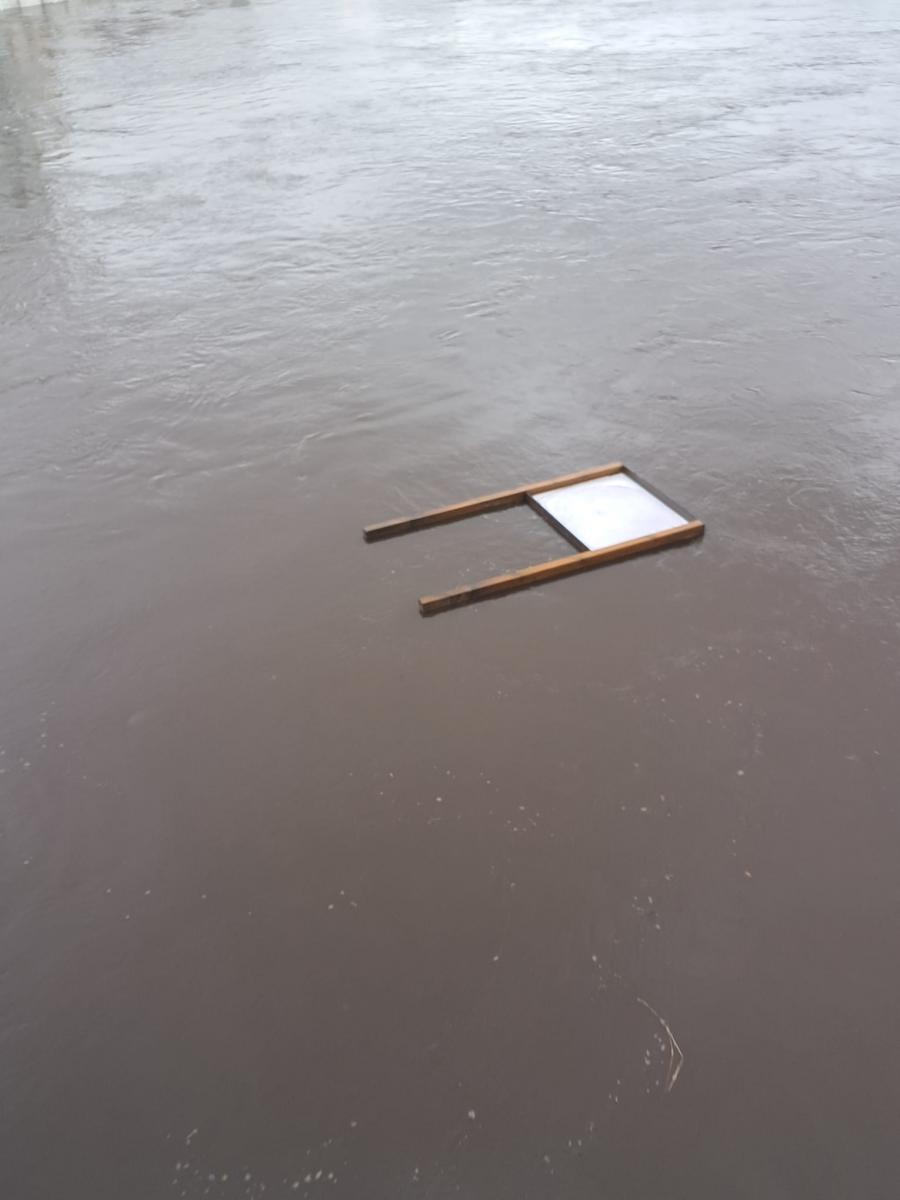
Although in most cases it has not yet been possible to evaluate the magnitude of the damage, previous experience indicates that events of this nature may imply partial or total loss of equipment and materials, such as the informational panels installed for environmental awareness under the LIFE Águeda Project, some of which have already been seen drifting along the Vouga River.
In other situations, activities were directly interrupted. In the Tagus estuary, high discharge prevented the monthly deployment of nets and traps to capture the Chinese mitten crab as part of an ongoing master’s thesis at the University of Évora on this invasive species. In another northern river, Joaquim Reis, researcher at MARE and ARNET at the Faculty of Sciences of the University of Lisbon, points to the risk of losing juvenile freshwater bivalve retention devices, potentially compromising seasonal and annual monitoring trials.
There are also contexts where, so far, no direct damage or immediate impacts on experimental protocols have been recorded. Nevertheless, indirect effects have already been identified, including sediment accumulation in the reservoir of the Ponte de Coimbra weir, associated with intensified sediment dynamics.
In the case of the Mondego River, Pedro Proença e Cunha, Professor of Geology at the University of Coimbra and coordinator of MARE’s Sedimentary Geology Research Group, has emphasised in recent publications that floods in the Lower Mondego are not solely the result of rainfall intensity, but also of hydraulic system management and land occupation patterns over recent decades. He recalls that the Mondego Hydraulic Project was designed so that a centennial flood, estimated at approximately 3,666 m³/s under natural conditions, would be attenuated to 1,200 m³/s when passing through Coimbra, through the upstream dam system and the channel with marginal levees built between Coimbra and Figueira da Foz. However, since 1990, discharge values exceeding those foreseen in the project have been recorded several times, including values close to or above 2,000 m³/s in 2001, 2019 and 2026, progressively weakening defence infrastructures such as levees.
The researcher also stresses that the absence of major floods in the decades following dam construction led to imprudent occupation of floodplains, exposing populations and infrastructure to significant risk. In his view, fluvial floods are not “natural disasters,” but phenomena inherent to river dynamics, with risk largely amplified by human occupation of alluvial plains and management decisions that constrain the system’s capacity to buffer peak flows.
Time series and scientific continuity at risk
A significant part of MARE’s research in river basins relies on long-term time series, which are essential for assessing ecological trends, water quality, and the effects of climate change.
The displacement or loss of fixed equipment may introduce gaps in continuous records, compromising interannual comparability and requiring protocol adaptations, device reinstallation and sampling schedule adjustments. The temporary suspension of field campaigns involving biological or environmental sampling also represents a relevant operational constraint. Nevertheless, as José Lino Costa, researcher at MARE and ARNET at the Faculty of Sciences of the University of Lisbon, indicates, “It may lead to delays, but we expect no major consequences.”
Researchers emphasise that extreme events are part of the natural variability of fluvial systems. The challenge lies in their potential intensification in both frequency and magnitude under climate change, which may require more robust, resilient monitoring strategies.
Ecological impacts: risks and opportunities
From an ecological perspective, floods play an ambivalent role.
Pedro Anastácio, researcher at MARE and ARNET at the University of Évora and Coordinator of MARE’s River Basin Research Domain, recalls that “Floods and floodplains are part of the natural hydrological cycle and spatial organisation. It is essential to understand that they are almost impossible to control and, in many cases, contribute to hydrological connectivity between systems that may otherwise be isolated.”
In some cases, these events may even enhance recruitment of certain populations, such as freshwater bivalves, through the “cleaning” of riverbeds. However, as Joaquim Reis explains, they may also cause massive mortality through downstream transport, temporary local extinctions, alterations in bed morphology, and temporary degradation of water quality.
There are also relevant implications for invasive species. Increased connectivity between systems may accelerate the spread of non-native aquatic organisms. The potential downstream dispersal of zebra mussels in the Tagus River was mentioned, should extreme events facilitate their transport from already invaded areas in Spain.
For migratory species studied by MARE and ARNET, periods of high discharge may represent both opportunities and risks, increasing connectivity and facilitating upstream migration while also increasing habitat instability.
José Lino Costa nevertheless underlines ecosystem recovery capacity: “Freshwater, estuarine and coastal ecosystems are adapted to these types of phenomena. They will be temporarily affected and then recover.”
Extreme events as scientific opportunity
Despite operational constraints, researchers converge on one point: these episodes also constitute scientific opportunities.
The intensification of extreme events enables testing ecological hypotheses often discussed in theoretical contexts, assessing population and habitat resilience to abrupt disturbances, and studying post-event recovery processes.
Bernardo Quintella frames these events strategically: “Recent events may contribute to deepening knowledge about aquatic ecosystem dynamics under scenarios of increased climate variability, aligning perfectly with MARE’s strategic objectives.”
In a context of increasing climate variability, understanding how freshwater, estuarine, and coastal systems respond to extreme events is essential to support evidence-based management and conservation policies.